The trouble with one good idea
For most of the history of design, a project moved in a straight line. You met the client, someone had an idea, the team developed it, and if the client did not like it, you started again. Budgets and deadlines meant that most brands only ever saw two or three directions before one was chosen.
That is not because designers lacked ideas. It is because every idea took days to make visible. The cost of exploring meant that many good options were never explored at all.
Where AI earns its place
This is the part of the process that artificial intelligence has changed for us. Today we can take a single conversation with a client and turn it into a wide field of possibilities in an afternoon: layouts, colour systems, tone of voice, campaign concepts, even rough first drafts of a website.
- More options, earlier. Clients see real alternatives in the first week, not the fourth.
- Less repetition. Resizing, versioning and first drafts are done in minutes.
- More budget for craft. The time saved goes back into the details people actually notice.
“AI widens the road. It does not choose the destination.”How we explain it to clients
Where a person has to decide
A machine can produce a hundred directions. It cannot know which one feels like your business, which one your customers will trust, or which one you will still be proud of in five years. Those are human judgements, and they are the heart of the work.
So we keep a simple rule: every decision that matters is made by a person, and nothing leaves the studio until a person has signed it off. AI is the instrument. The people around the table are the musicians.
What it looks like in practice
Every project begins with a short written brief. It is the most important document in the process, because the quality of everything the machine produces depends on the clarity of the human thinking behind it. Here is a simplified version of the kind of brief we start from:
# A family bakery in Limassol, third generation
who:      locals and visitors who care where food comes from
feeling:  "warm, honest, a little bit proud"
avoid:    "rustic clichés, wheat illustrations, brown everything"
explore:  40 logo directions · 12 colour systems · 3 tones of voice
decide:   the owners and our designer, together
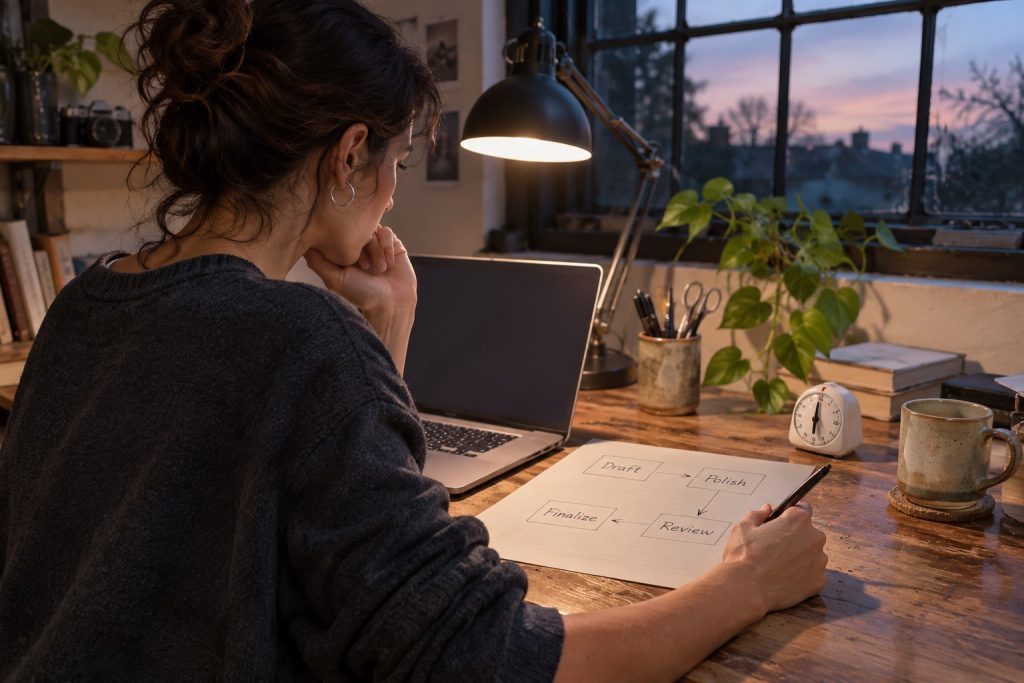
From there, the machine explores and the team curates. We bring the strongest directions to the client, talk them through in person, and then a designer develops the chosen one by hand, line by line.
What this means for you
Working this way gives you more choice, faster, without giving up the care that makes a brand feel like yours. You see more possibilities early, you make the decisions that matter, and the finished work is reviewed and approved by real people at every step.
If that sounds like the way you would like to work, we would love to hear about your project.