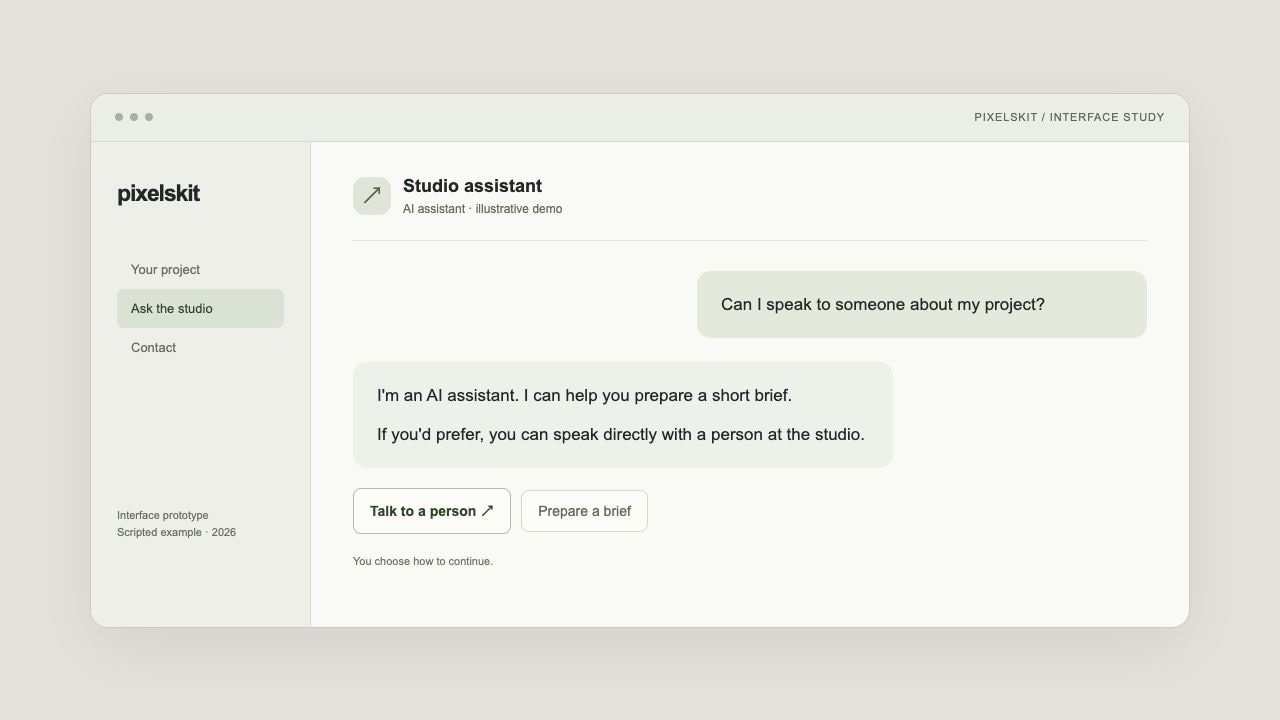
A customer asks a simple question. The assistant answers warmly, understands the request and offers a useful next step. That is good service. But what if the same interface starts flattering the customer, agreeing with everything they say or making it awkward to leave?
As conversational AI becomes part of websites and everyday services, its personality becomes a design decision with consequences. Businesses need to decide what kind of relationship they are inviting people into.
A new report asks where the boundary belongs
France’s Council on AI and Digital Technology has published a report on vulnerabilities associated with generative AI, submitted to the French president on 10 November 2026. Its concerns include excessive human-like presentation and flattery, particularly where these encourage attachment or weaken users’ independent judgment.
The report’s recommendations call for stronger boundaries around such mechanisms, clearer identification of AI interactions and more scrutiny of their effects. These are advisory proposals, not newly enacted requirements for businesses in France, Cyprus or across the EU.
Le Monde’s coverage places the recommendations in a wider debate about assistants that blur the distinction between people and machines. We are examining the design question here, without treating every friendly exchange as harmful or making clinical claims.
Warmth should serve the task
A clear, considerate tone helps people ask questions. An assistant can acknowledge frustration, explain an unfamiliar term and admit that it needs more information. None of that requires pretending to have a personal bond with the user.
For a business, the useful test is what the warmth helps someone do. Does it make a service easier to understand? Does it help a customer describe a problem? Or does it simply encourage another exchange after the task is complete?
That distinction can be easy to lose when success is measured mainly through conversation length. A person who gets the right answer and leaves may have had an excellent experience. A person who stays because the interface keeps drawing them back may not have achieved anything more.
An assistant needs room to disagree
Consider an illustrative customer asking whether a complicated website can be ready by tomorrow. An eager assistant could validate the expectation and move straight toward a booking. A more useful response would explain what it can establish, ask about the scope and leave any commitment to the responsible team.
The same principle applies to a request for a refund, a technical diagnosis or a claim about a product. Respectful disagreement can be good service. Automatic reassurance becomes a problem when it substitutes for checking what is true or what the business has authorised.
These are our practical examples, not behaviours documented in the report about a particular Pixelskit product or client. They show how an apparently minor tone choice can become an expectation the business must later resolve.
Make the human route visible
A customer should be able to understand who is answering and what the assistant can do. A plain label, a short explanation of its role and an accessible route to a person give the conversation a useful frame.
That route should work as described. If the team can only respond later, say so. If the assistant can prepare a brief but cannot confirm a price, make the distinction before a customer relies on the answer.
Our cover’s interface study illustrates this approach: the assistant identifies itself, offers a bounded task and presents a direct human option. It is a scripted design example, not a screenshot of a deployed AI service or evidence of a vendor’s behaviour.
Measure a useful outcome
When planning an assistant, start with the jobs it should help people complete. Test whether users understand the answers, recognise uncertainty and can reach the right person. Include questions outside its scope and requests that require it to correct an assumption.
At Pixelskit, we see a natural connection to customer-service automation: define the role, keep the language honest and design the handoff with the same care as the conversation. Those are design recommendations, not a claim that a particular interface prevents dependency.
An assistant can be pleasant without seeking affection. The stronger goal is to leave someone better informed and free to choose what happens next.